



MST2
MST2 (STK3) is a core Hippo pathway kinase that regulates organ size, self-renewal, tissue homeostasis, apoptosis, and tumor suppression through MST1/2-LATS1/2 control of YAP/TAZ activity[1][2]. Mechanistically, MST2 participates in MST1/2-dependent phosphorylation signaling to MOB1, LATS1/2, and YAP, linking cell contact, substrate stiffness, growth control, and stress-associated apoptosis[1][3]. In cancer models, MST2 contributes to apoptosis machinery in HER2+ breast cancer cells, while STK3 activation inhibits ESCC proliferation and migration through FOXO1-TP53INP1/P21 signaling[3][4]. Compared with related isoforms, MST2 differs functionally from MST1 because MST2 was essential for MST1/N activation and apoptosis induction, and differs from MST3 because MST3 regulates AMPK and YAP-Hippo signaling in renal fibrosis models[3][5]. For experimental applications, XMU-MP-1 is a reversible MST1/2 inhibitor that blocks MST1/2 kinase activity, activates YAP, and promotes liver and intestinal repair in acute and chronic injury models[6].
References:
- [1]. Passi M, et al. CDK5 interacts with MST2 and modulates the Hippo signalling pathway. FEBS Open Bio. 2025 Apr;15(4):647-660. [Content Brief]
- [2]. Cinar B, et al. The pro-apoptotic kinase Mst1 and its caspase cleavage products are direct inhibitors of Akt1. EMBO J. 2007 Oct 31;26(21):4523-34. [Content Brief]
- [3]. Turunen SP, et al. FGFR4 phosphorylates MST1 to confer breast cancer cells resistance to MST1/2-dependent apoptosis. Cell Death Differ. 2019 Dec;26(12):2577-2593. [Content Brief]
- [4]. Zhao Z, et al. STK3 kinase activation inhibits tumor proliferation through FOXO1-TP53INP1/P21 pathway in esophageal squamous cell carcinoma. Cell Oncol (Dordr). 2024 Aug;47(4):1295-1314. [Content Brief]
- [5]. Chan CH, et al. MST3 Regulates AMPK and YAP-Hippo Signaling in Cell Models Relevant to Renal Fibrosis. Biomol Ther (Seoul). 2025 Jul 1;33(4):704-715. [Content Brief]
- [6]. Fan F, et al. Pharmacological targeting of kinases MST1 and MST2 augments tissue repair and regeneration. Sci Transl Med. 2016 Aug 17;8(352):352ra108. [Content Brief]
All Product Categories
-
MST2 Related Products (3)
Related Products (3)

-
SBP-3264
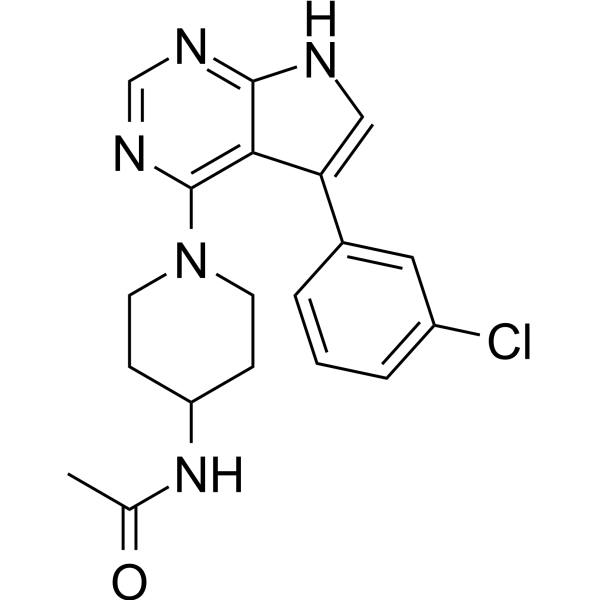 0 ImagesSBP-3264 is a YAP activator and STK/MST inhibitor with IC50 values of 36 nM against STK3/MST2 and 24 nM against STK4/MST1. SBP-3264 modulates the Hippo signaling pathway. SBP-3264 can be used for the research of acute myeloid leukemia.
-
IHMT-MST1-39
 0 ImagesIHMT-MST1-39 is an orally active inhibitor for MST kinase, with IC50 of 42, 109, 286, 159 nM for MST1, MST2, MST3, MST4. IHMT-MST1-39 activates the AMPK signaling pathway in liver cells, reduces apoptosis of pancreatic β-cells. IHMT-MST1-39 can be used for the studies of type 1 diabetes (T1D) and type 2 diabetes (T2D).
-
YL-602
 0 ImagesYL-602 is an orally active Hippo pathway activator. YL-602 activates the Hippo pathway via MST1/2, with downstream pathway activation. YL-602 inhibits YAP and CTGF expression in cells irrespective of cell density and serum presence. YL-602 induces tumor cell apoptosis and inhibits colony formation. YL-602 suppresses tumor growth in mice. YL-602 can be used for the research of cancer, such as breast cancer.



